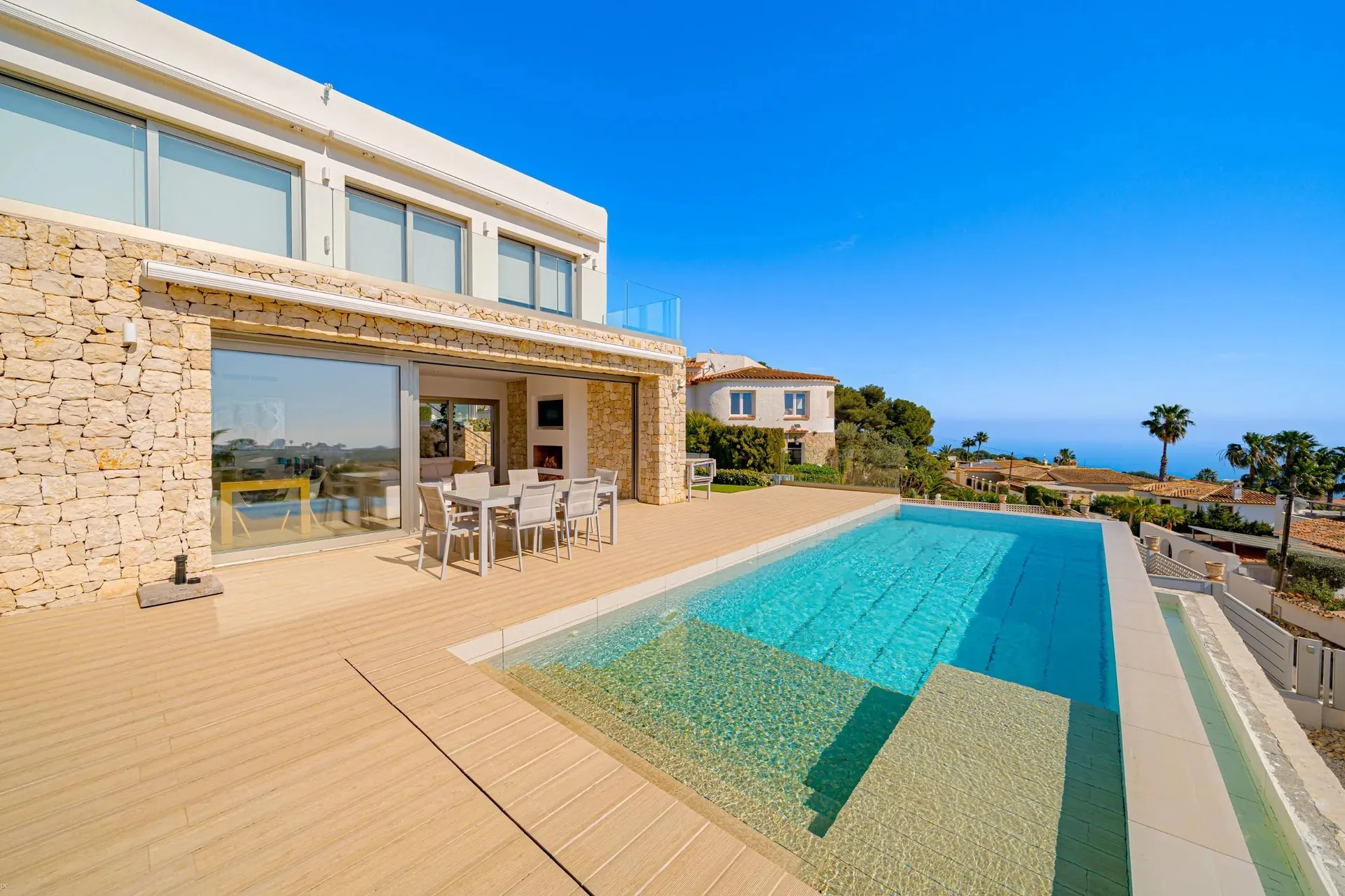
A hillside villa in Jávea, where architecture, light, and privacy come into balance
Hillside villas in Jávea offer a considered balance of topography, light, and privacy, where architecture follows the land and indoor-outdoor living becomes seamless. These homes appeal to Northern European buyers seeking both family space and a place to step back, work remotely, and return with clarity.
There’s a particular quality to hillside villas in Jávea that doesn’t immediately announce itself.
You notice it gradually.
Not just in the view, although that’s often the first impression, but in how the house sits. How it opens. What it chooses not to show.
Some properties here are built for visibility. Others, more carefully considered, are built for control.
And that distinction tends to matter to a certain type of buyer.
This is precisely the kind of thinking reflected in properties such as Villa Marian in Jávea, where the hillside, the sea view, and the architecture are resolved as one.
The land comes first
In Jávea, the most compelling villas rarely begin with architecture.
They begin with slope.
Plots in areas such as Balcón al Mar don’t offer a flat canvas. They require decisions. Access from above or below. How the volume steps down. Where the first line of sight is held back, and where it is released.
Done well, the house doesn’t dominate the hillside. It follows it.
You arrive without spectacle. Sometimes even with a sense of restraint. Then, a few steps further in, the horizon appears, wider than expected.
It’s a subtle choreography, but it changes how the property is experienced. Less immediate impact, more lasting clarity.
Orientation is not just about the view
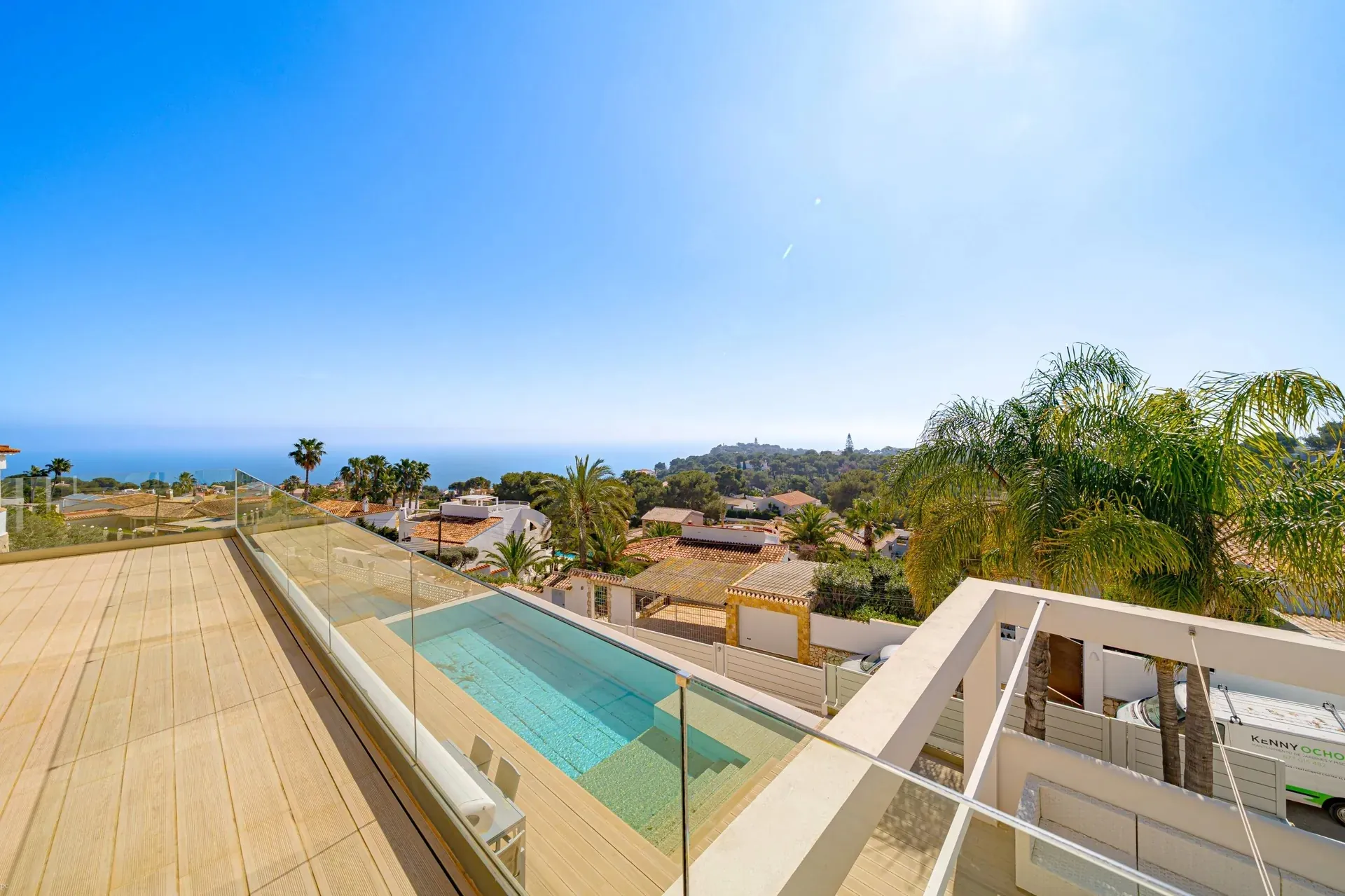
Sea views are easy to understand but light is more complex.
In Jávea, orientation shapes the day in ways that aren’t always obvious in photographs. Morning light falling into the kitchen, not the bedroom. A terrace that holds shade long enough to be usable in August. Living spaces that soften toward the evening rather than glare.
White façades, so common along this stretch of coastline, are not just aesthetic choices. They reflect light back into the house. They reduce contrast. They allow interiors to remain calm even at midday.
Stone does something different. It absorbs. Grounds. Holds temperature.
Together, they create a balance that feels almost unspoken, but becomes noticeable the longer you stay.
For anyone working remotely, even part of the time, this begins to matter. Where you sit with a laptop. When you step outside. How long you remain focused before the view interrupts, or perhaps resets, your attention.
Privacy, defined by what you don’t see
From the street, many of these villas reveal very little. Walls. A controlled entrance. Limited openings.
It can feel almost closed.
But step through, and the entire logic reverses.
The house opens outward, toward the sea, toward space. Sightlines extend in one direction and are carefully blocked in another. Neighbours disappear without distance needing to increase.
This is what privacy looks like here. Not isolation, but direction.
It allows a family to occupy the house fully, terraces, pool, living spaces, without the subtle awareness of being overlooked. At the same time, the connection to the landscape remains intact.
You are aware of where you are. Just not of who is watching.
Inside and outside, less separation than expected
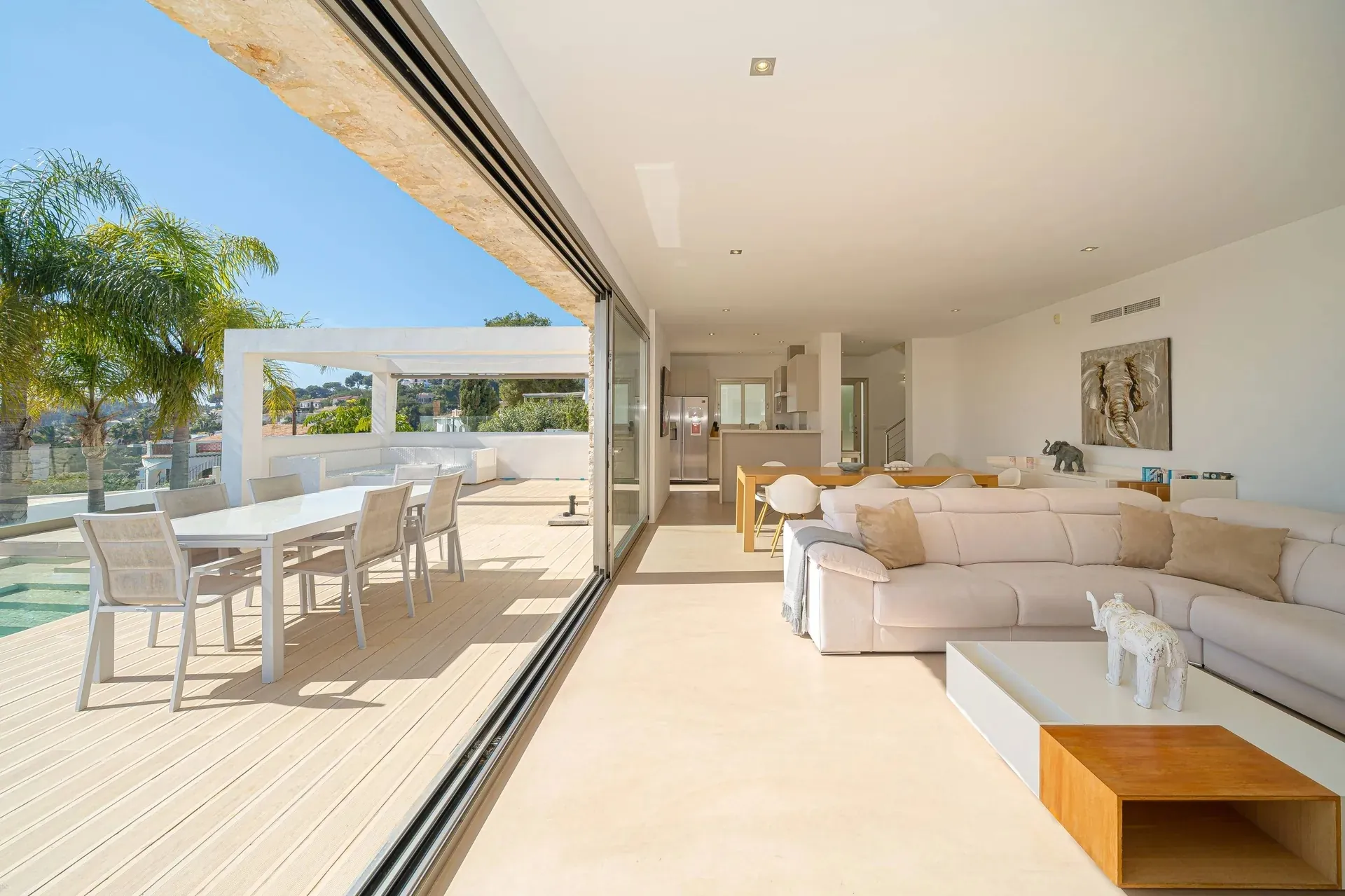
One of the quieter shifts in more contemporary villas in Jávea is how little distinction there is between interior and exterior.
Sliding glass panels that disappear entirely. Flooring that continues from living room to terrace without interruption. Covered outdoor spaces that feel less like additions and more like extensions of the house.
It changes behaviour.
Breakfast moves outside without planning. Evenings extend without transition. Movement through the house becomes less linear, more fluid.
For families, particularly those spending longer periods here during school or university breaks, this creates a different rhythm. Less structured. More shared space, but without compression.
There is room to withdraw, but also room to drift back together.
Materials that belong to the place
There’s a consistency to the better villas in Jávea, and increasingly in parts of Moraira and Altea, that goes beyond style.
Local stone, often rough-cut or dry-laid, anchors the building. It gives weight where the land falls away. It connects the structure to something older, more permanent.
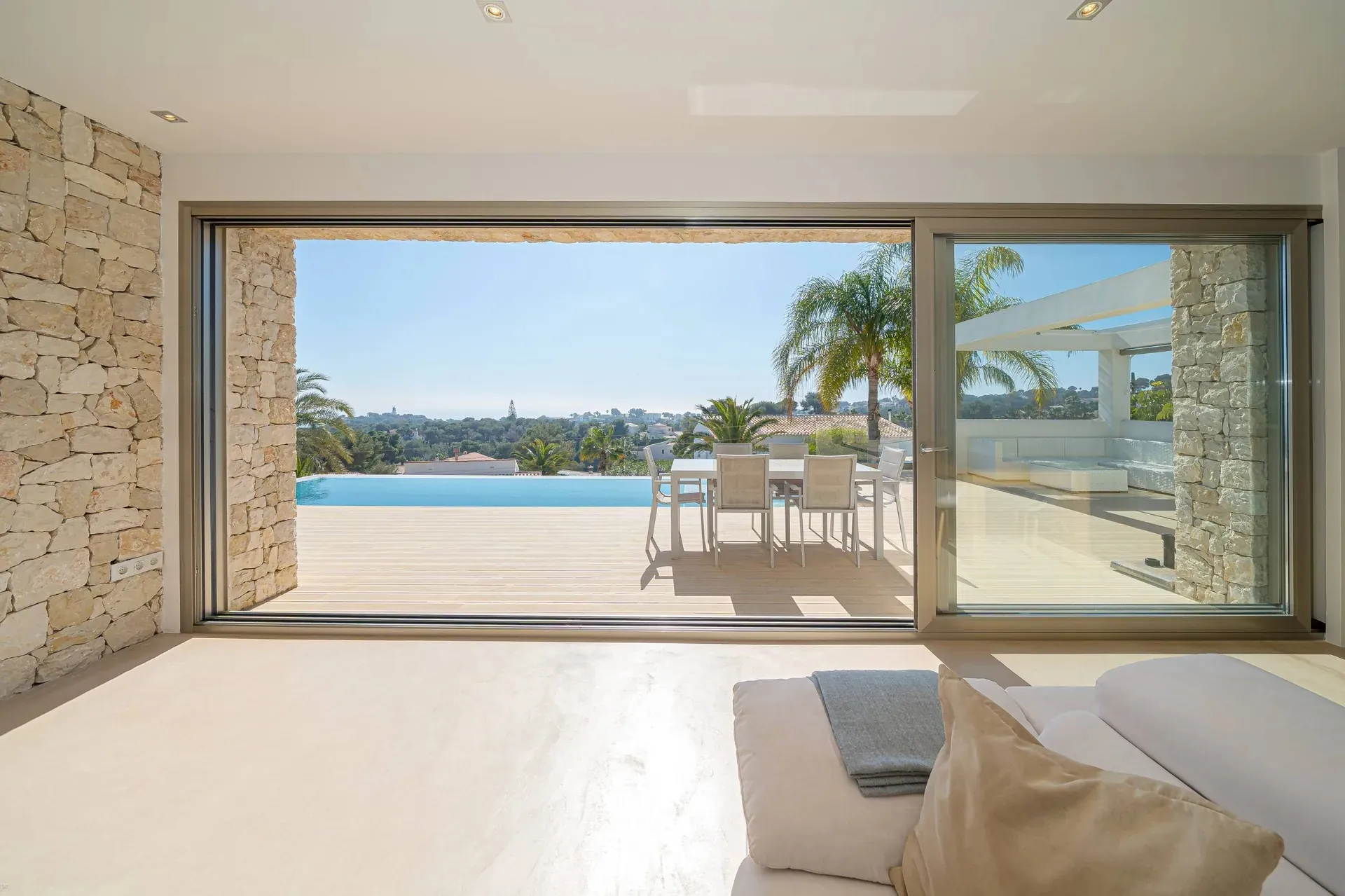
White volumes sit against this, lighter, more responsive to light than to mass.
The contrast is deliberate.
Stone holds the hillside. White opens toward the horizon.
Inside, this language continues in quieter ways. Textural surfaces. Neutral palettes. Materials that reflect rather than compete with the surroundings.
It’s not minimalism in the strict sense. More a reduction of distraction.
A different kind of second home
For many buyers from Northern Europe, Jávea offers something that is difficult to replicate further north.
Not just climate, but tempo.
A place where the day expands slightly. Where time is less segmented. Where work, when it happens, sits alongside rather than above everything else.
A morning call taken on a shaded terrace. An afternoon that drifts toward the pool. Evenings that extend without needing to move elsewhere.
And then, inevitably, a return to a more structured environment.
What these houses offer is not escape in the dramatic sense, but recalibration. Enough distance to think differently. Enough continuity to return without friction.
That tends to matter more over time than any single feature.
A reference point in Jávea
There is a villa currently available in Jávea that brings many of these elements together, topography, orientation, controlled privacy, and a clear relationship between interior and exterior spaces.
It doesn’t attempt to dominate the hillside. It follows it. It doesn’t expose itself. It frames what matters.
It works well as a reference. Not because it is unique, but because it illustrates how these principles come together when they are resolved carefully.
Beyond Jávea
While Jávea offers one of the most established markets for this type of hillside villa, similar approaches can be found in parts of Moraira and, increasingly, in Altea’s elevated enclaves.
The underlying principles remain consistent.
Topography first. Light managed, not maximised. Privacy directed, not imposed.
The details change. The intention does not.
Final observation
Not every sea view property achieves this balance.
Some prioritise view at the expense of usability. Others lean too heavily on architecture without fully resolving how the house will be lived in.
The more enduring villas tend to be quieter in their ambition.
They don’t try to impress immediately. They settle. They align with the land, with the light, with the way people actually move through a space over days, not minutes.
Returning to the Jávea villa mentioned earlier, it becomes easier to see how these elements come together, the way the house settles into the hillside, opens toward the horizon, and maintains a sense of calm, controlled privacy throughout.
And that, more often than not, is what experienced buyers recognise first.
FAQs
Why are hillside villas in Jávea often more private than coastal properties?
Because of orientation and elevation. Many plots are accessed from above, allowing the house to open toward the sea while remaining closed to the street, which limits overlooking without needing large distances between neighbours.
Does a sea view always mean a better investment on the Costa Blanca?
Not always. The combination of view, orientation, and privacy tends to matter more than the view alone. Poorly oriented properties can overheat or feel exposed, which affects long-term desirability.
Are hillside villas practical for families staying for extended periods?
In most cases, yes. Contemporary villas are designed with level transitions between main living areas and terraces, making day-to-day living straightforward, even on sloped plots.
What should buyers consider when working remotely from a villa in Jávea?
Beyond connectivity, orientation and shading matter. Spaces with controlled light and access to outdoor areas tend to be used more consistently for work than fully enclosed interiors.
Are similar hillside properties available outside Jávea?
Yes. Parts of Moraira and Altea offer comparable plots and architectural approaches, although Jávea remains one of the most established markets for this type of property.