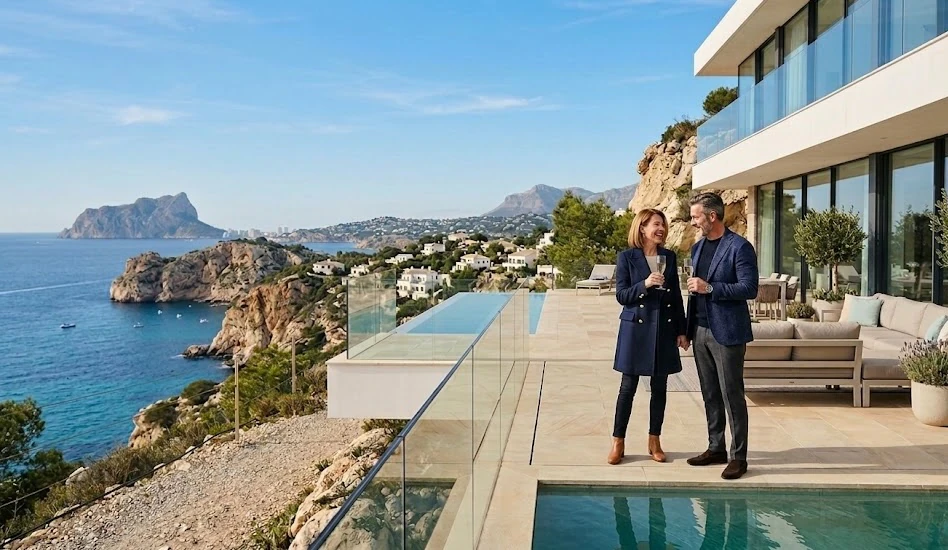
Living on the Costa Blanca All Year Round: Reality Versus Perception
There are not a small number of people who first encounter the Costa Blanca in summer and assumes they have understood it.
The sea is flat and bright. Lunch stretches late into the afternoon. Villas are opened fully to the terraces, children move between pool and shade, and the rhythm feels simple because, for a few weeks, life has been simplified. No school run and no practical administration beyond restaurant bookings, airport transfers and perhaps a second visit to a property that has started to feel rather less hypothetical than it was a couple of weeks ago.
Then comes the more serious question.
Could we live here all year?
For many international buyers considering Jávea, Moraira, Benissa, Altea or the wider northern Costa Blanca, this is the point at which perception begins to meet reality. Not in a negative sense in fact often quite the opposite. The Costa Blanca is one of the few Mediterranean regions where year-round life can be genuinely practical, elegant and well supported. But it is not the same place in January as it is in August. Summer reveals the spectacle whereas winter reveals the structure.
And frankly that can make a difference. A house that feels irresistible for three weeks in July is not automatically the right house for February, school terms, medical appointments, remote work, visiting family, elderly parents, airport logistics or a quieter social calendar. For buyers at the upper end of the market, the decision is rarely about whether the Costa Blanca is pleasant. It is about whether it can support a life with enough depth, continuity and discretion.
The answer is usually yes. But the conditions matter.
The summer image is only one version of the coast
The Costa Blanca has suffered, a little, from the success of its own image. For decades, the shorthand has been familiar: beaches, long lunches, golf, villas, palm trees, easy flights, retirement, second homes. None of that is false but it is not the complete picture.
A buyer who only sees the coast in high season may experience a version of the region that is busier, brighter and more performative than daily life actually feels. Restaurants are full. Parking near the Arenal in Jávea or around Moraira’s centre can become a tactical exercise. Beach clubs and chiringuitos operate at full pitch. Roads that feel quiet in May suddenly become compressed by hire cars, scooters and families heading to the water with parasols and inflatable kayaks.
This is the Costa Blanca many people know.
But the year-round version has a different texture. In October, the light becomes softer and the sea is often still warm enough for swimming. In November, terraces remain usable at lunchtime, but evenings begin to ask for a jacket. In January, the coast is not abandoned, but it is stripped back. You notice who actually lives there. You notice which restaurants serve local residents rather than summer traffic. You notice which areas retain activity when the shutters come down elsewhere.
That is where good buying decisions begin.
There is a difference between a beautiful summer address and a resilient year-round location. The former may rely on seasonal energy. The latter has services, access, healthcare, community, food shopping, schools, professional networks, transport routes and enough life outside July and August to make the house feel inhabited rather than stored.
This does not mean buyers should avoid seasonal areas. Some of the most desirable enclaves on the northern Costa Blanca are calm for much of the year, which is precisely their attraction. It does mean that buyers should be honest about the kind of life they expect to lead.
A family using the property during school holidays will judge winter differently from a couple relocating permanently. A semi-retired buyer who travels frequently will have different priorities from someone running a company remotely. A design-led buyer may be willing to accept more seclusion if the architecture, orientation and view are exceptional. A buyer with older parents visiting regularly may place greater value on proximity to private healthcare, flat access and reliable transport.
The question is not whether the Costa Blanca works year-round. It is where, and for whom.
Off-season life: quieter, but not closed
One of the most persistent perceptions about Mediterranean coastal towns is that they close outside summer.
In some resorts, that is largely true. On parts of the Spanish coast, winter can feel like an afterthought. Restaurants close for months. Local services reduce. Streets designed around tourism lose their function once the visitors leave. The result can be strangely hollow: beautiful weather, good sea views, and very little happening underneath.
The northern Costa Blanca is more nuanced.
Jávea, Moraira, Benissa, Dénia and Altea all have seasonal fluctuations, but they are not simply summer resorts. They have established resident populations, local economies, expat communities, schools, clinics, tradespeople, municipal services and cultural calendars that continue beyond the tourist season. Dénia in particular has the weight of a real working town, with its port, markets, gastronomy and administrative services. Jávea has a layered structure, with the historic centre, port and Arenal each offering different forms of life. Moraira is smaller and more polished, but it retains enough year-round activity to support daily living. Altea has cultural depth, a working old town and a more artistic identity.
Winter on the Costa Blanca can be exceptionally pleasant for those who do not need constant entertainment. There is space again. Walking routes feel more generous. The coves around Granadella, Portichol or Benissa Costa are no longer performance spaces for summer photography. Inland roads toward Jalón, Parcent or Alcalalí become part of normal weekend life rather than “excursions”. The terraces still matter, but the interior of the house begins to matter more. Morning light in a kitchen. A sheltered courtyard. A living room that receives winter sun. Underfloor heating that has been properly specified. Glazing that does not turn the house into a cold stone box after sunset.
This is where property selection becomes more subtle.
A villa designed only for summer may reveal its weaknesses in the cooler months. North-facing rooms, exposed terraces, poor insulation, shaded pools, inadequate heating, difficult access roads and overly open layouts can all become irritating once the holiday lens disappears. In contrast, a well-oriented house with winter sun, protected outdoor areas, efficient heating and a coherent indoor-outdoor flow can feel more luxurious in January than in August.
Luxury, in this context, is not spectacle. It is comfort that continues when the weather is less theatrical.
What remains open matters more than what closes
When buyers ask whether a town is “open” all year, they are often asking the wrong question.
The better question is what remains open, and for whom.
A town does not need every restaurant, boutique and beach bar operating in February to support a refined year-round life. It needs the right services to remain dependable. Good food shopping. Pharmacies. Clinics. Banks or reliable alternatives. Lawyers, notaries and tax advisors within reach. Restaurants that locals actually use. Cafés with morning life. Fitness studios, tennis clubs, golf clubs, marinas, language schools, cultural venues, builders’ merchants, interior suppliers, garden maintenance companies and people who answer the phone outside August.
The northern Costa Blanca performs well on this measure, but not evenly.
Dénia is the strongest year-round service centre in the Marina Alta. It has the administrative and commercial gravity of a town that was never built solely around tourism. For owners in Jávea, Moraira and surrounding residential zones, Dénia often becomes part of practical life: medical appointments, more extensive shopping, restaurants, professional services, ferry connections to the Balearics, and a broader local calendar.
Jávea offers a different balance. The old town, port and Arenal behave almost like three related but distinct settlements. The old town gives continuity, with municipal life, markets and traditional streets that are not dependent on summer. The port has a more local maritime feel, with restaurants and services that remain useful beyond the season. The Arenal is more seasonal, but still active enough to be part of everyday life. For buyers considering areas such as Tosalet, Portichol, Granadella, La Lluca, Montgó or Adsubia, the key is not simply distance to the beach. It is how quickly and comfortably the property connects to the services they will actually use in February.
Moraira is more compact. That is part of its charm. It has a controlled, low-rise feel and an atmosphere that many northern European buyers find immediately legible. It is pretty, manageable, safe-feeling and polished without becoming urban. Off-season, it becomes quieter, but not empty. Buyers who want constant variety may feel the need to use Dénia, Jávea or Calpe more often. Buyers who want a composed coastal base often find that Moraira’s winter restraint is part of its appeal.
Benissa is different again. Benissa Costa offers proximity to the sea and coves, while Benissa pueblo and the inland areas give more traditional year-round life. The municipality is extensive, and the experience of living there depends heavily on micro-location. A villa near the coast may feel private and serene, but more car-dependent. A property closer to the town or within easy reach of Calpe, Moraira or Teulada may offer a more practical balance.
Altea, particularly around Altea Hills, Sierra de Altea and the old town, attracts buyers who value architecture, views and cultural atmosphere. The presence of nearby Benidorm, often underestimated by luxury buyers, adds practical weight: hospitals, entertainment, transport, shopping and a larger working population. One does not have to want to live in Benidorm to benefit from its infrastructure.
This is the part many buyers overlook during the first search. The most elegant life may not be in the busiest location, but it needs to be connected to one.
Transport links: the difference between holiday access and life access
For second-home buyers, transport usually means flight time but for year-round residents, it means something broader.
It means whether your adult children can visit for a long weekend without losing a day to logistics. Whether you can reach Brussels, Amsterdam, Düsseldorf, London, Stockholm or Geneva with reasonable frequency. Whether a late arrival requires a difficult mountain road in the dark. Whether you can travel for work without feeling cut off. Whether friends can visit without turning the journey into a minor expedition.
On this point, the Costa Blanca has a structural advantage.
Alicante-Elche Miguel Hernández Airport is not a small seasonal airport. Aena lists it among Spain’s major airports, with around 20 million passengers in 2025, and its official route information currently shows 137 destinations served by 39 airlines. That breadth matters. It supports the international character of the coast and makes year-round ownership more realistic for buyers whose lives remain connected to northern Europe.
The airport is particularly important for Jávea, Moraira, Benissa and Altea because it combines scale with manageable distance. Depending on the exact location and traffic, many homes in the northern Costa Blanca sit within roughly one to one and a half hours of Alicante Airport. Valencia Airport may also be relevant, especially for properties further north around Dénia, Jávea and the Marina Alta. For some European routes, Valencia can offer useful alternatives.
This dual-airport logic is one of the region’s underappreciated strengths.
A buyer in Jávea, for example, may default to Alicante, but Valencia can be a valuable second option depending on season, airline and destination. A buyer in Altea may lean more naturally toward Alicante. A buyer in Moraira or Benissa sits in a practical middle zone, with Alicante generally dominant but Valencia still within reach for certain journeys.
The road network also matters. The AP-7 and N-332 are the two main reference points, but their usefulness depends on where the property sits in relation to access points. A villa may be only a few kilometres from the sea, yet still require winding local roads that add time to every journey. Another may sit slightly inland but connect more quickly to the motorway, making airport transfers, hospital visits and regional travel more straightforward.
For buyers who travel often, this should be considered with some precision.
A spectacular sea-view villa at the end of a narrow road may be exactly right for an owner who wants privacy and visits several times a year. It may be less ideal for someone expecting weekly flights, regular guests, teenage children coming and going, or elderly relatives who dislike complicated transfers. The difference between thirty-five minutes and fifty-five minutes to a motorway junction does not matter much on holiday. Over several years, it changes the feel of ownership.
The northern Costa Blanca is made of coves, slopes, headlands, valleys and residential enclaves. Its beauty is partly the result of that topography. The same contours that create privacy and views also create dependence on roads, access and orientation. A buyer who understands this from the beginning will make a better decision than one who applies urban expectations to a coastal landscape.
Private healthcare: one of the strongest arguments for year-round confidence
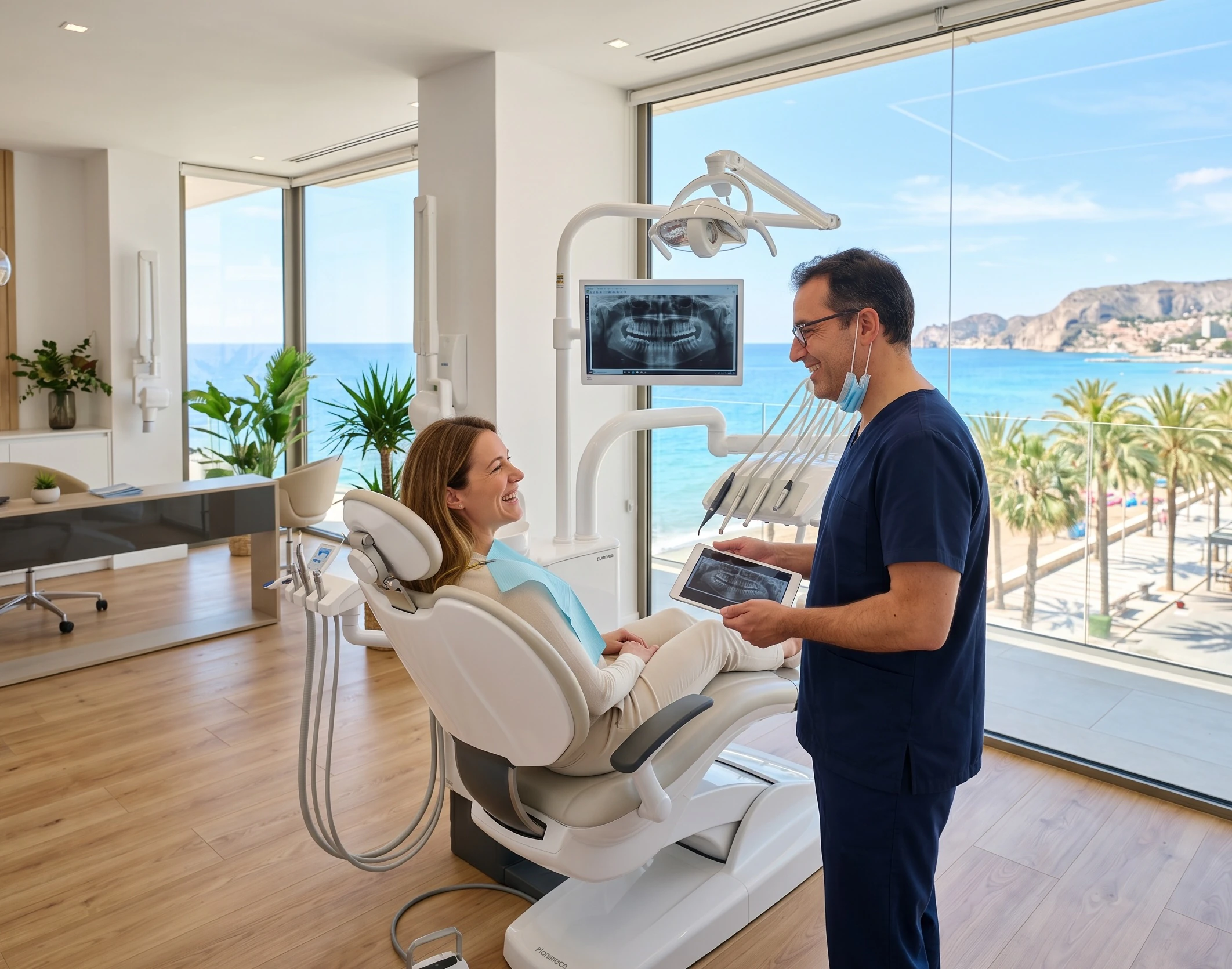
For younger families, it may appear as a practical question: paediatricians, dentists, emergency care, physiotherapy, specialists, insurance coverage. For buyers in their fifties, sixties or seventies, it becomes more central. They may be active, healthy and independent, but they know that access to good medical care changes the emotional equation of living abroad.
The Costa Blanca is well positioned in this respect.
The region has a mix of public and private healthcare infrastructure, and the private sector is particularly relevant for international residents who want shorter waiting times, multilingual attention and direct access through insurance. In the northern Costa Blanca, HCB Dénia is an important reference point for the Marina Alta. HCB describes the hospital as a private centre with hospitalization, emergency services, ICU and outpatient consultations across more than 6,500 square metres. Further south, IMED Levante in Benidorm describes itself as serving the Marina Baixa and Marina Alta areas, and as the largest private hospital in the Province of Alicante after its expansion.
For buyers comparing the Costa Blanca with more remote Mediterranean areas, this infrastructure carries weight.
It means that a villa in Jávea, Moraira, Benissa or Altea is not simply a beautiful retreat. It sits within reach of serious medical services. That matters for permanent relocation, for older residents, for families with children, and for owners who expect parents or guests to stay for extended periods.
The practical reality is still location-specific. A house in central Jávea has a different healthcare profile from a secluded villa above a cove. A property in Altea Hills has fast access toward Benidorm’s medical infrastructure, while a home near Dénia may benefit from proximity to HCB Dénia and the broader services of the town. Moraira and Benissa owners often think in terms of both Dénia and Benidorm, depending on the service required.
Insurance should also be addressed early. Many international buyers arrange private health insurance before residency or relocation, and the details matter: age limits, pre-existing conditions, exclusions, reimbursement models, hospital networks, language support and whether certain specialists are included. A buyer with a wealth advisor or relocation consultant may already have this in hand. Others discover too late that the difference between policies is not marginal.
Knowing that healthcare is accessible allows buyers to relax into the life they came for. Without that confidence, even a beautiful home can feel slightly provisional. You may enjoy the terrace, the pool, the view and the winter sun, but some part of you remains unconvinced that life is properly supported. For year-round living, emotional ease depends on practical depth.
Good healthcare access does not make a location luxurious by itself. But its absence can quickly make luxury feel fragile.
The off-season social question
There is another perception that deserves attention: the idea that winter on the Costa Blanca is socially thin. Obviously this comes down to personal choice.
Some people want privacy above all. They are not looking for a large social circle, club life or constant invitations. Their ideal winter involves reading on a sheltered terrace, walking in the Montgó, working remotely from a well-designed study, hosting close friends and eating in a small number of restaurants where the staff know them by sight. For them, the off-season is not a compromise. It is the point.
Others want a more active social life. They want tennis, paddle, golf, sailing, cycling groups, international networks, gallery openings, food markets, language classes, charity events, school communities or business contacts. They may not want a loud life, but they do want a connected one.
The Costa Blanca can offer both, but buyers should choose accordingly.
Jávea has one of the more established international communities, with a mix of long-term residents, families, retirees, entrepreneurs and second-home owners. The social structure is dispersed, but it exists. Moraira has a strong northern European presence and a more compact social geography. Dénia offers a broader Spanish and international mix, with more urban texture. Altea brings a cultural layer, especially for buyers interested in art, music, restaurants and the old town’s slower, more atmospheric life. Inland valleys such as Jalón and Orba offer a different form of community: less polished, more rural, often attractive to buyers who want space, landscape and authenticity without being too far from the coast.
For families, schools become part of the social map. International schools in the wider region can shape where people live, how they move and whom they meet. A property that seems ideal for summer may become complicated if daily school logistics are awkward. For semi-retired couples, clubs, healthcare, restaurants and airport access may matter more. For remote-working professionals, fibre internet, workspace, acoustic separation and proximity to a reliable café or coworking option may be surprisingly important.
Climate reality: generous, but not always effortless
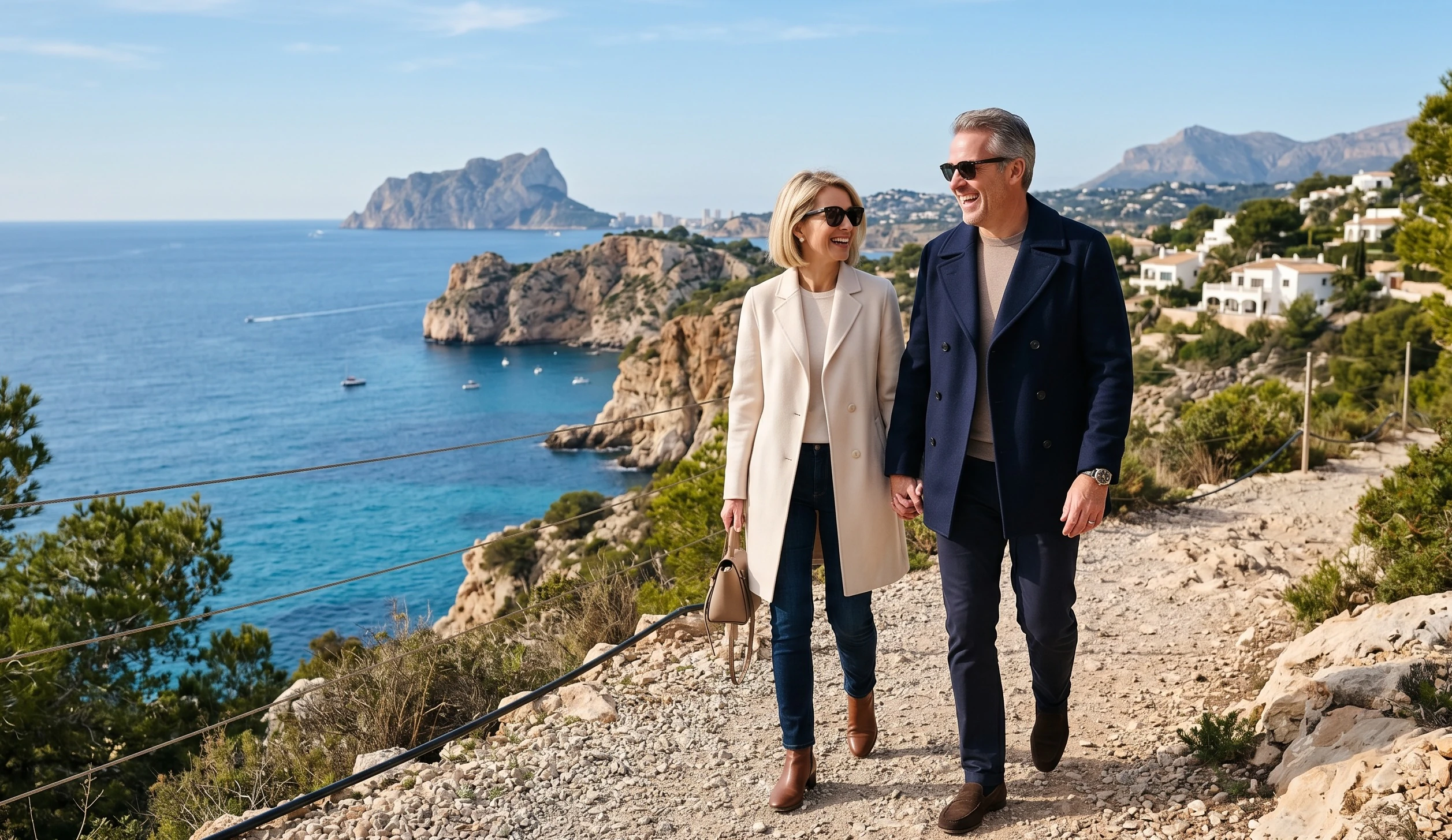
The Costa Blanca climate is one of its great assets. That does not mean it should be treated as a permanent summer.
Winter can be mild, bright and deeply pleasant, especially compared with northern Europe. Lunch outdoors in January is not unusual. Walking, cycling and golf often become more enjoyable outside the high heat of summer. The sea, the mountains and the light all feel less crowded.
But there are cooler evenings, damp weeks, windy days and occasional storms. Some microzones are more exposed than others. Orientation mattersand so does elevation and the way a house was built.
A south-facing terrace protected from the wind can transform winter living. A pool that receives sun for most of the day will be used more often than one shaded by neighbouring walls or pine trees. A living room with proper glazing and winter light feels entirely different from one designed only to open wide in August. Bedrooms need warmth and ventilation. Bathrooms need proper heating. Outdoor kitchens are wonderful, but indoor kitchens matter more than many summer buyers realise.
Heating systems, insulation, window quality, solar orientation, ventilation, pool heating, shading, drainage and maintenance access all influence year-round comfort. At the luxury level, these are not secondary details. They are part of the value.
The best homes on the Costa Blanca do not merely perform in summer; they adapt.
They offer shade in August, sun in January, privacy without isolation, openness without exposure, and interiors that remain inviting when the terraces are wet. They understand that Mediterranean living is not only about being outside. It is about the relationship between inside and outside changing across the year.
The difference between a holiday town and a living region
The Costa Blanca is often spoken about as if it were one continuous lifestyle product. It is not.
Living in Altea is not the same as living in Moraira. Living in Jávea’s Montgó area is not the same as living near the Arenal. A villa in Granadella offers a different rhythm from a townhouse in Dénia or a hillside property above Benissa Costa. These differences become more pronounced outside summer.
For buyers drawn to restaurants, shopping and cultural events within easy reach, Dénia or Altea tend to feel more natural. Those seeking a polished coastal village atmosphere may find Moraira a better fit, while buyers who value variety, an international community and the ability to choose between distinct microzones often gravitate toward Jávea. Anyone prioritising privacy, land and long-term value, meanwhile, would do well to look more closely at Benissa, particularly where plot size, orientation and planning stability are strong.
The inland areas should not be dismissed either.
For some buyers, the year-round Costa Blanca becomes more interesting once they stop looking only at the first line of the sea. The Jalón valley, Alcalalí, Llíber and Parcent offer landscape, space and a more grounded rhythm, while remaining connected to the coast. The light is different. The evenings can be cooler. The social environment is more local, sometimes more integrated, and less shaped by summer tourism. For the right buyer, that can feel more authentic than a coastal address.
For others, proximity to the sea remains non-negotiable. That is also valid. The mistake is not wanting the sea. The mistake is refusing to examine what that choice implies in February, March or November.
The strongest decisions come from matching lifestyle to micro-location.
Not every buyer needs the same level of service density. Not every buyer wants silence. Not every buyer wants a village centre. Not every buyer wants neighbours. The role of a good advisor is not to push one version of the Costa Blanca, but to interpret which version will continue to work once the first emotional response to the view has settled.
Remote work and the new year-round owner
The profile of the year-round buyer has changed cince the pandemia. A decade ago, permanent relocation was often associated with retirement. That still exists, but it is no longer the whole story. Today, many buyers are in their forties, fifties or early sixties and remain professionally active. Some run companies and travel frequently. Some work in hybrid rhythms, moving between northern Europe and Spain. Yet others use the Costa Blanca as a family base while maintaining business interests elsewhere.
This has changed what buyers expect from a home. A study is no longer a spare bedroom with a desk. It may need privacy, sound control, proper lighting, video-call presentation, fast internet, storage, and separation from family life. A guest suite may need to function as a workspace when family are not visiting. A garage will undoubtedly need EV charging. A kitchen may need to support both family living and informal entertaining. Outdoor spaces need to work across seasons, not only as summer scenery.
The Costa Blanca suits this new rhythm because it allows a particular kind of decompression without cutting owners off from Europe. A buyer can fly back for meetings, host clients discreetly, spend school holidays with adult children, and maintain a healthier daily routine. Cycling, swimming, walking, tennis and golf are not occasional leisure activities here. They can become part of the week.
But the property must support that rhythm.
A remote-working owner may enjoy privacy, but not if the house feels isolated after three months. They may value views, but not if glare makes the main living space uncomfortable on a laptop. They may want open-plan architecture, but not if every call echoes through the house. They may want guests, but not if there is no real separation between family zones and visitor accommodation.
Reality versus perception: the honest balance
So, what is the reality of living on the Costa Blanca all year round?
It is more practical than many people assume. The airport connections are strong. Private healthcare is accessible. International communities are established. Services continue through the year in the main towns. The climate supports an outdoor life far beyond the summer months. For buyers who choose well, the region can offer a rare balance of beauty, infrastructure and personal space.
You will need a car in most luxury residential locations. Some restaurants and services will close or reduce hours off-season. Microclimates matter. Not every area has the same winter life. Healthcare and insurance should be organised carefully. The most secluded homes require the most honest thinking about access. A summer property is not always a year-round home.
The Costa Blanca rewards buyers who look closely. It rewards those who understand that the best life here is not built on permanent holiday mood, but on rhythm, comfort and intelligent choices. The sea matters, of course and so does the view. But the deeper value is found in the less photographed details: winter sun, a good road home, a trusted doctor, a town that remains alive in January, a house that feels settled when the guests have left.
For many international buyers, that is the real luxury.
If you are considering a year-round move to the Costa Blanca, the choice of micro-location matters as much as the property itself. Grupo Garcia can help you compare areas, services, access, healthcare proximity and the seasonal rhythm of each location, so your decision is based on how life will actually feel beyond the summer months.
Use the enquiry form on any property that interests you, or contact our team to discuss which part of the northern Costa Blanca best fits the way you intend to live.
FAQs
Is the Costa Blanca genuinely liveable all year round, or does it close down in winter?
The northern Costa Blanca — particularly Dénia, Jávea, Moraira, Benissa and Altea — retains meaningful year-round life. These are not pure resort towns; they have resident populations, local services, healthcare, schools and cultural calendars that continue outside summer. The experience does become quieter, but for many buyers that is part of the appeal.
Which area offers the best year-round infrastructure?
Dénia carries the most weight as a year-round service hub, with hospitals, markets, administrative services and ferry connections. Jávea offers a layered structure across its old town, port and Arenal. Moraira is more compact and polished but quieter off-season. Altea suits buyers who value culture and atmosphere. The right choice depends on how the buyer intends to live day-to-day.
How good are the transport links for residents who still travel frequently for work?
Alicante-Elche Airport serves around 20 million passengers annually across 137 destinations, making it a genuine international hub. Valencia Airport offers a useful secondary option, particularly for properties in the Marina Alta. Most homes in the northern Costa Blanca sit within roughly one to one and a half hours of Alicante, though exact road access and proximity to motorway junctions varies and should be factored into property decisions.
What should buyers know about private healthcare in the region?
The northern Costa Blanca has solid private healthcare infrastructure. HCB Dénia serves the Marina Alta with emergency, inpatient and outpatient services, while IMED Levante in Benidorm is described as the largest private hospital in Alicante province. Buyers are advised to arrange private health insurance before relocating, paying close attention to age limits, exclusions, specialist coverage and hospital networks.
What makes a property genuinely suitable for year-round living, rather than just summer use?
Key factors include south-facing orientation to capture winter sun, sheltered outdoor areas, proper insulation and heating systems, high-quality glazing, a well-functioning interior layout, and practical access to main roads. A villa designed purely for summer — with exposed terraces, poor heating and difficult access — can feel uncomfortable once the holiday mindset fades. The best year-round homes adapt across seasons rather than performing only in August.
This article examines what year-round life on the northern Costa Blanca (Jávea, Moraira, Benissa, Altea, Dénia) actually looks like beyond the summer months, helping international property buyers make informed decisions that go beyond their initial holiday experience. It covers how the region functions off-season, the importance of micro-location for services and healthcare access, transport links via Alicante and Valencia airports, climate realities, the evolving profile of remote-working buyers, and how to match lifestyle needs to the right area. Grupo Garcia are a northern Costa Blanca property agency specialising in helping international buyers find the right luxury home for year-round living.