Family Buyers and Forever Homes: What They’re Really Looking for in 2026
The families arriving in the Northern Costa Blanca this year are not looking for a holiday home. They are looking for a second life, one that runs in parallel, not in retreat.
They have already done the research. They know the difference between Jávea and Moraira. They have a view preference, an architect shortlist, and a number in mind that they are prepared to move on. What they have not yet found is the property that justifies the decision they have already made.
That is the gap this market exists to fill.
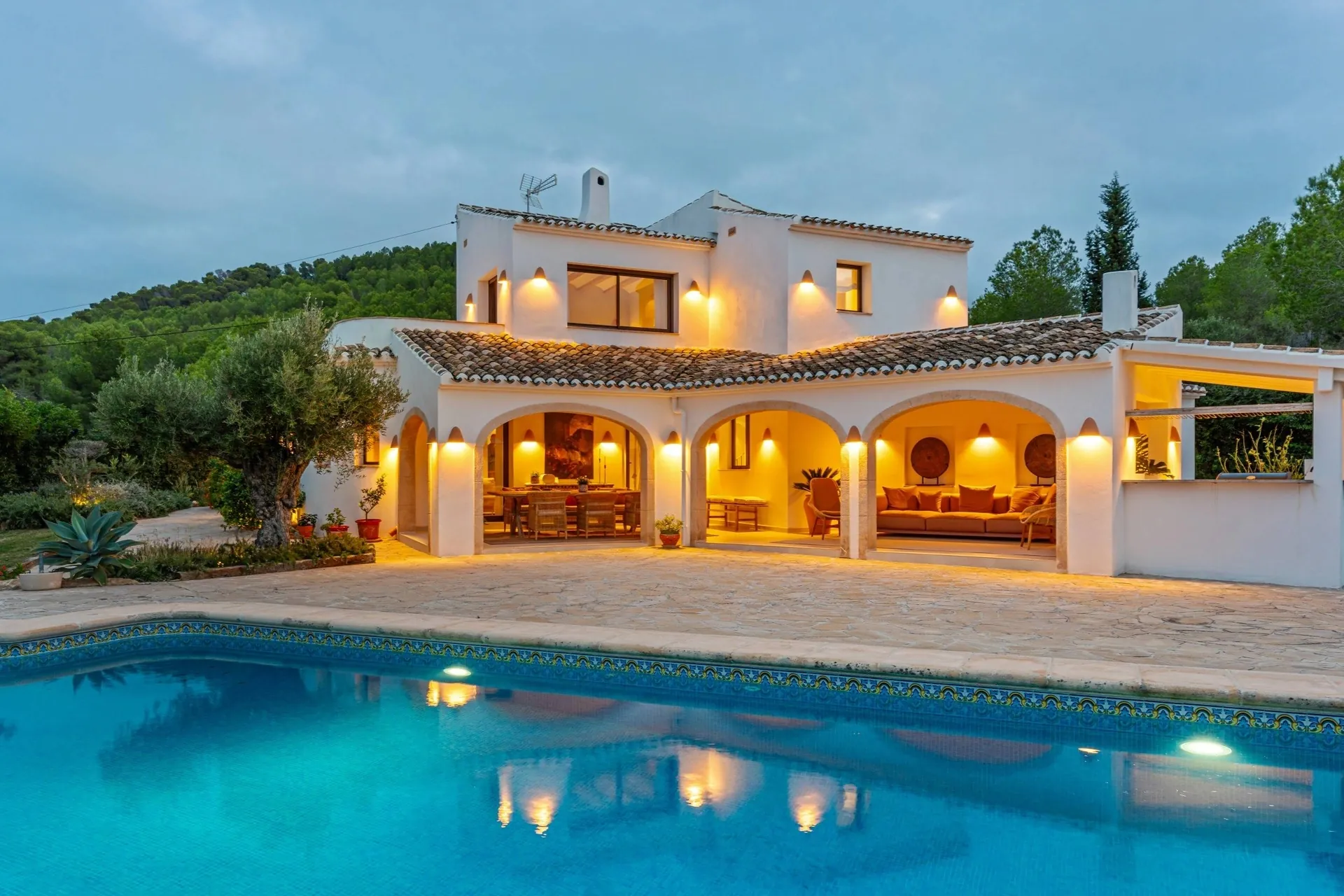
Properties like this Ibiza-style villa in Les Rotes illustrate the shift clearly. Set just steps from the sea, its layout is not simply about openness or light, but about how a family might actually inhabit the space over time, with separate zones, considered flow between indoor and outdoor living, and a quiet sense of privacy that doesn’t rely on isolation.
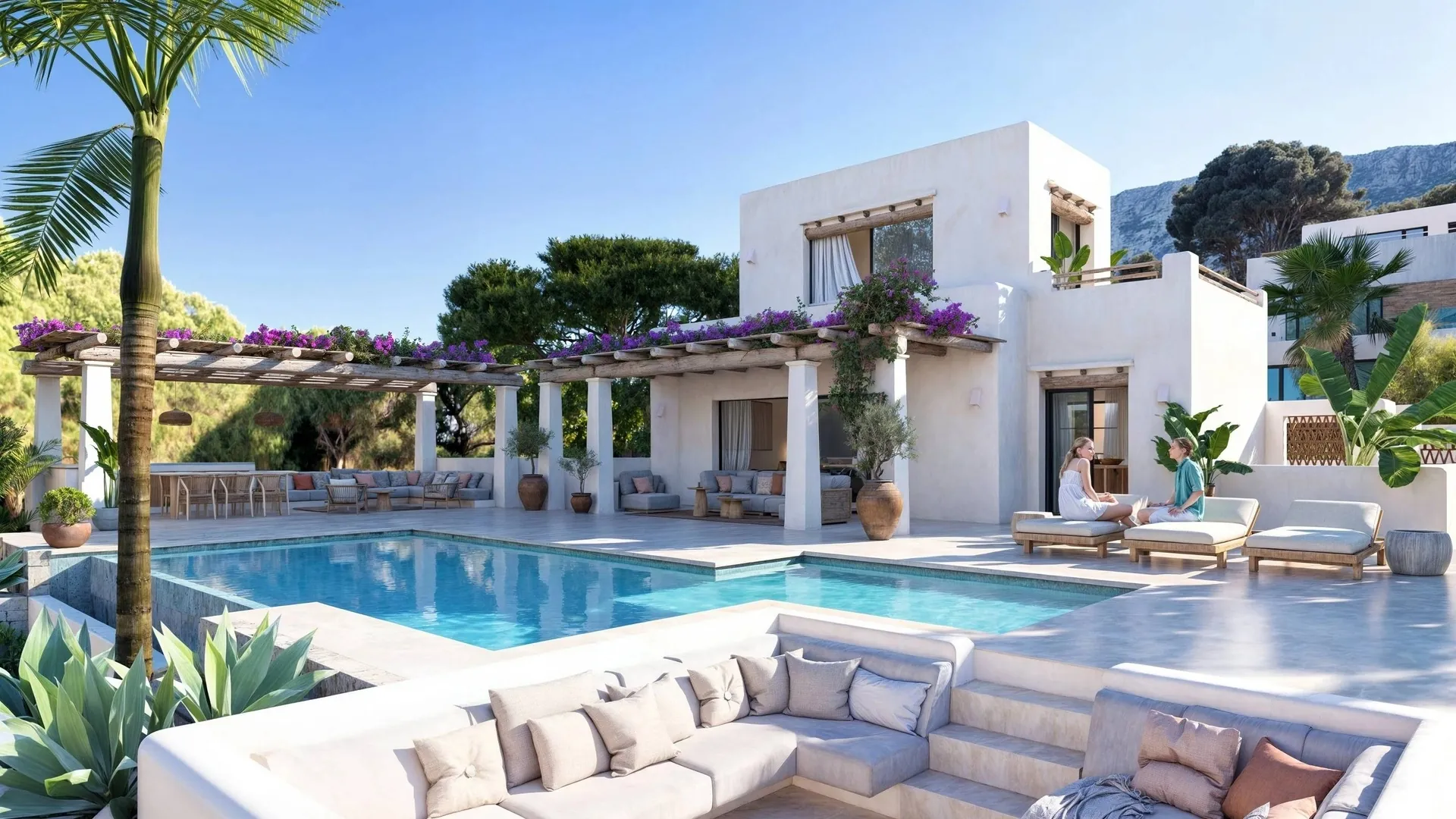
The idea of a “forever home” has become more fluid
A decade ago, a forever home implied something fixed. A long-term commitment to a single way of living. Today, it is almost the opposite. A forever home now needs to absorb change.
Children grow. Work patterns evolve. Parents age. Time spent in Spain often increases gradually rather than all at once. The property has to accommodate all of this without feeling compromised at any stage.
That is why flexibility has quietly become one of the most valued attributes in the Northern Costa Blanca market.
In areas such as Jávea, Moraira, Benissa Costa, and the nearby inland valleys, buyers are drawn to properties where space is not only generous, but structured in a way that allows it to evolve.
A lower level that can function independently. A guest wing that does not feel secondary. A space that works as an office today, and a bedroom tomorrow. Terraces that shift with the seasons, open and expansive in summer, more sheltered and enclosed in winter.
The house, in effect, becomes a framework rather than a fixed layout.
That is what gives it longevity.
Multi-generational living, without compromise
One of the more noticeable shifts is not necessarily in size, but in how space is organised.
For years, the market placed emphasis on bedroom count. Four, five, sometimes six bedrooms, presented almost as a measure of value. That still matters, of course. But it is no longer the deciding factor.
What matters is how those rooms relate to each other. The typical family buyer in 2026 often has a more complex structure than in the past. Teenagers who come and go between countries. Adult children who stay for extended periods. Parents who visit for months rather than weeks. Occasional staff, depending on the property.
This creates a need for subtle separation. Not isolation, but independence.
In the hillside areas of Jávea, particularly around Montgó, or in the elevated plots of Benissa, the terrain itself often allows for this. Split-level designs, terraces at different heights, discreet access points. All of it contributes to a sense that different parts of the home can operate independently without losing cohesion.
A well-considered property might include a secondary living space that does not feel like an annex. A kitchen that can be used separately without disrupting the main flow. Bedrooms positioned to allow privacy without disconnect.
These are not headline features. They rarely appear in listings in any meaningful way.
But buyers notice them almost immediately. And once they do, it becomes difficult to go back to a more conventional layout.
Education quietly shapes the search
It is rarely the opening question. But it becomes one of the most decisive.
Schools.
For international families, particularly those relocating from the Netherlands, Belgium, Germany, or the UK, education is not simply about availability. It is about continuity, curriculum, and environment.
In the Northern Costa Blanca, this has a direct impact on where people choose to buy.
The presence of schools such as Xàbia International College, Lady Elizabeth School in Cumbre del Sol, or the wider network accessible from Altea and Alicante, creates very specific search patterns.
Distance matters, but not in the abstract.
It is the daily reality that counts. The drive in the morning. The reliability of the route. The existence of school transport. How the journey feels in winter, not just in August.
This is where some properties, despite their architectural appeal, fall away.
A villa with a commanding view but an impractical school run becomes harder to justify. Another, perhaps more understated, but positioned within an easy, predictable commute, gains quiet preference.
There is also a social dimension.
International schools create communities. Families with similar backgrounds, languages, and expectations. For buyers arriving from Northern Europe, this offers a degree of familiarity that smooths the transition.
The property, in that sense, is only one part of a broader ecosystem.
Domotics as infrastructure, not a feature
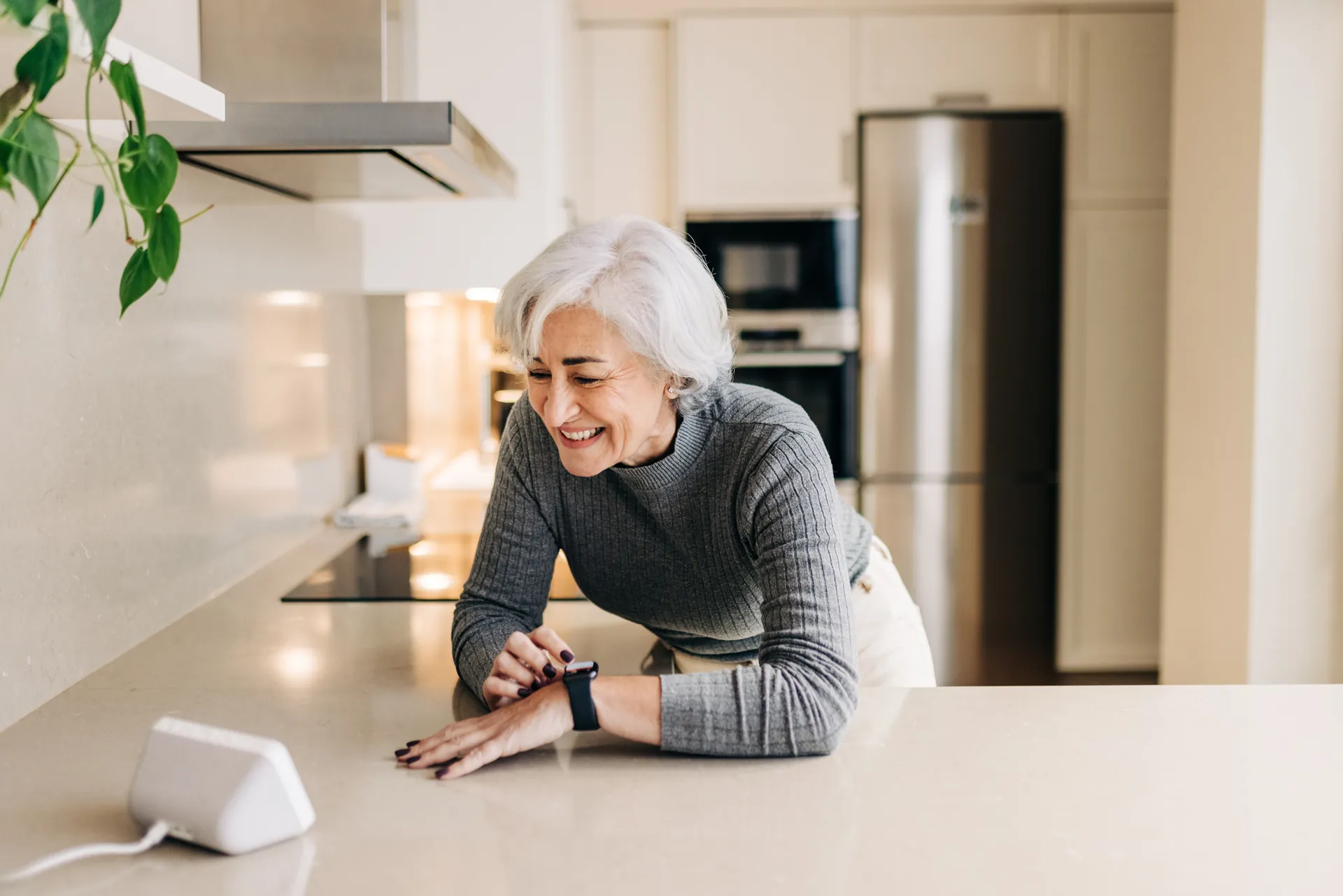
A few years ago, home automation was something that might be demonstrated during a viewing. Lights dimming on command, blinds adjusting, music playing across zones.
Now, in this segment, it is assumed. But the expectation has shifted. It is less about novelty, more about coherence.
Climate control that responds to how the house is actually used. Large properties are rarely occupied in full at all times, so zoned heating and cooling becomes essential. Shading systems that adapt throughout the day, particularly on south and west-facing façades. Integrated security, managed discreetly. Access control that allows for flexibility when the property is used intermittently or shared across family members.
Energy management is increasingly part of the conversation as well.
Solar installations, battery storage, aerothermal systems. Not necessarily driven by environmental positioning, but by practicality. Homes that can maintain efficiency without constant oversight are simply easier to live with.
For a family that may not be in residence year-round, this matters.
The expectation is straightforward. You arrive, and everything works as it should.
Architecture that supports daily life
There is a difference between a house that presents well, and one that lives well. The former tends to rely on more immediate impressions. Volume, glazing, uninterrupted views.
The latter reveals itself more gradually.
It is in the way the kitchen connects to the terrace. How movement through the house feels intuitive rather than forced. The way light enters in the morning, and how it softens towards the evening.
In the Northern Costa Blanca, contemporary architecture has become more responsive in this regard. Less formulaic. More adapted to the specifics of each plot.
Natural materials are used with intention. Local stone that grounds the building. Timber elements that introduce warmth without compromising durability. Glass used expansively, but balanced with shade and protection.
The result is not necessarily more striking at first glance.
But it holds together over time.
And that is what matters in a property intended for long-term living.
Hybrid working has redefined spatial priorities
This is one of the more practical shifts, but also one of the most influential.
Many family buyers are no longer fully detached from their professional lives when in Spain. Work continues, at least in part and that requires proper space.
Not an improvised desk in a corner, but a considered environment. Good acoustics. Reliable connectivity. Natural light that supports long periods of concentration. Enough separation to allow focus, without disconnecting entirely from the rest of the home.
In some cases, two such spaces are needed. Couples working simultaneously. Older children studying remotely.
This has implications for both design and location.
Connectivity, both digital and physical, becomes part of the evaluation. Proximity to services, access to airports, the ease of moving between Spain and other European bases.
It is a subtle shift, but one that has had a noticeable impact on how properties are assessed.
Outdoor space, rethought
The traditional formula remains. Terrace, pool, outdoor dining.
But it has evolved.
For family buyers, outdoor areas are now expected to function as genuine extensions of the interior.
Outdoor kitchens that are fully equipped, not symbolic. Covered dining areas that can be used across seasons. Lounge spaces with fire elements that allow for use beyond summer months. Gardens that provide structure, privacy, and usability, rather than serving purely decorative purposes.
On larger plots, this often leads to a form of zoning outside as well. Spaces for children. Areas for relaxation. Perhaps even a small sports zone.
The intention is clear. The exterior should not be secondary.
Why the Northern Costa Blanca continues to attract this buyer
Many of these families have looked elsewhere before arriving here. Ibiza, Mallorca, the south of France. All considered. Sometimes visited extensively.
Yet the Northern Costa Blanca continues to draw them in. The climate is stable. Access is straightforward, with Alicante and Valencia both within reach. The cost, while significant at the upper end, remains more accessible than some competing locations. But more importantly, there is a sense of normality.
These are places that function year-round.
Jávea, Moraira, Benissa. They do not shut down outside of peak season. There are schools, services, a rhythm that continues through winter.
For a family seeking continuity rather than occasional escape, that matters.
It allows the property to become a base, not just a destination.
Finding a home that works not just now, but over time, requires a more considered approach.