New-Build or Resale? What Buyers Above €2 Million Need to Think About on the Northern Costa Blanca
A considered guide for buyers above €2 million on the Northern Costa Blanca, weighing new-build against resale across four dimensions: design control, build timelines, quality oversight, and finished product reality. Written for the discerning lifestyle buyer. Favours new-build when conditions are right, while treating resale as an equally legitimate path when the property is resolved.
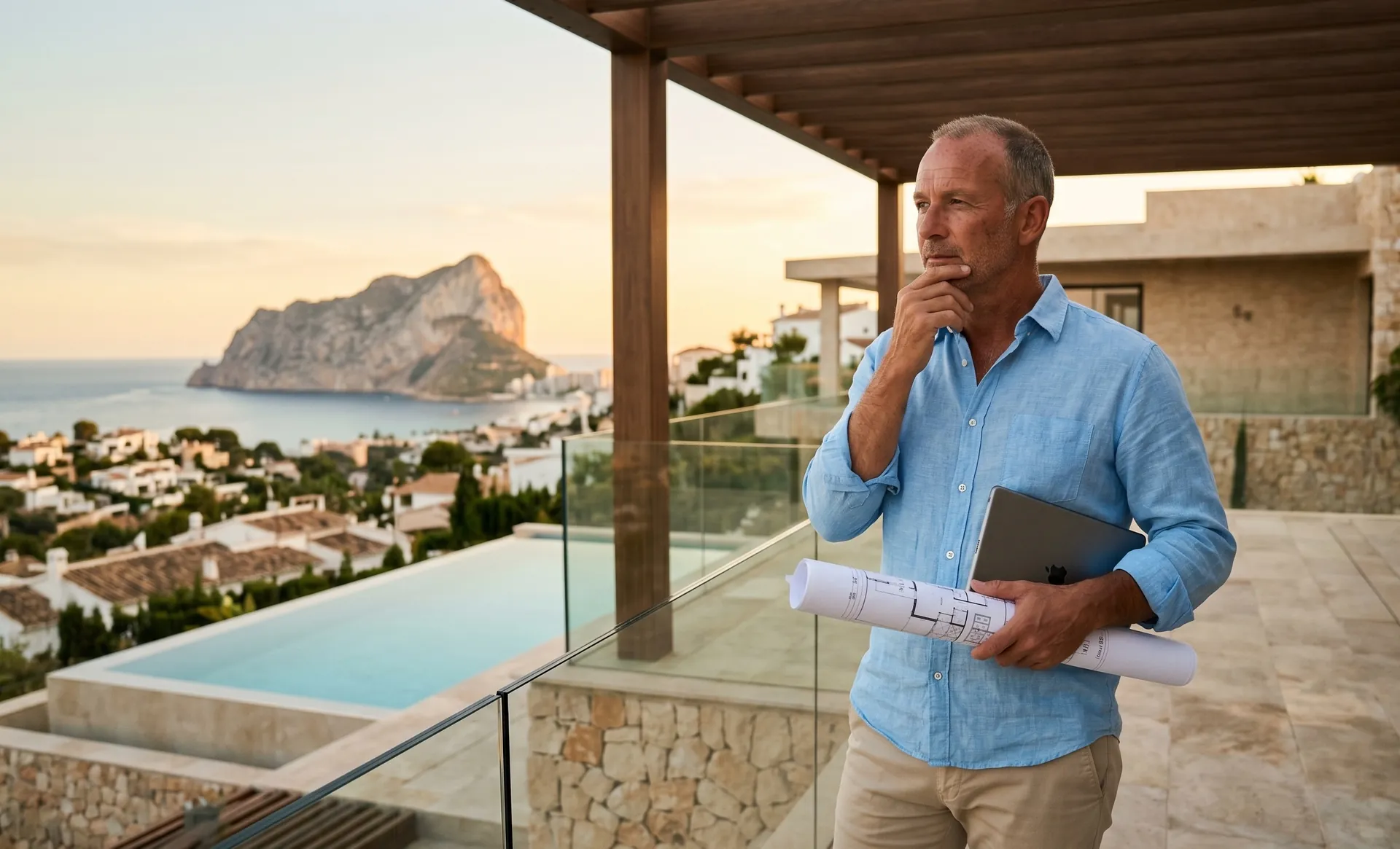
R.B. is 53. Lives in Rotterdam. He runs a mid-size logistics firm and has spent the better part of two decades building something that lets him, finally, think about what comes next. His wife wants mornings by a pool. His eldest daughter is about to leave for university in Amsterdam. The younger one still has two years of school left, which means the family isn't moving full-time, not yet, but they want a base. Something real. Something that won't feel like a compromise the moment they arrive in July.
He's been watching the Northern Costa Blanca for about eighteen months. He knows the difference between Moraira and Jávea. He's walked Calpe on a Tuesday in October when there are no tourists and realised he actually likes it. He's looked at enough floor plans to know that 400m² on paper and 400m² in reality are not always the same conversation.
What R.B. hasn't fully resolved yet is whether to buy new or existing. And that question, in this price bracket, in this market, deserves a considered answer.
The appeal of new-build is real. So is the complexity.
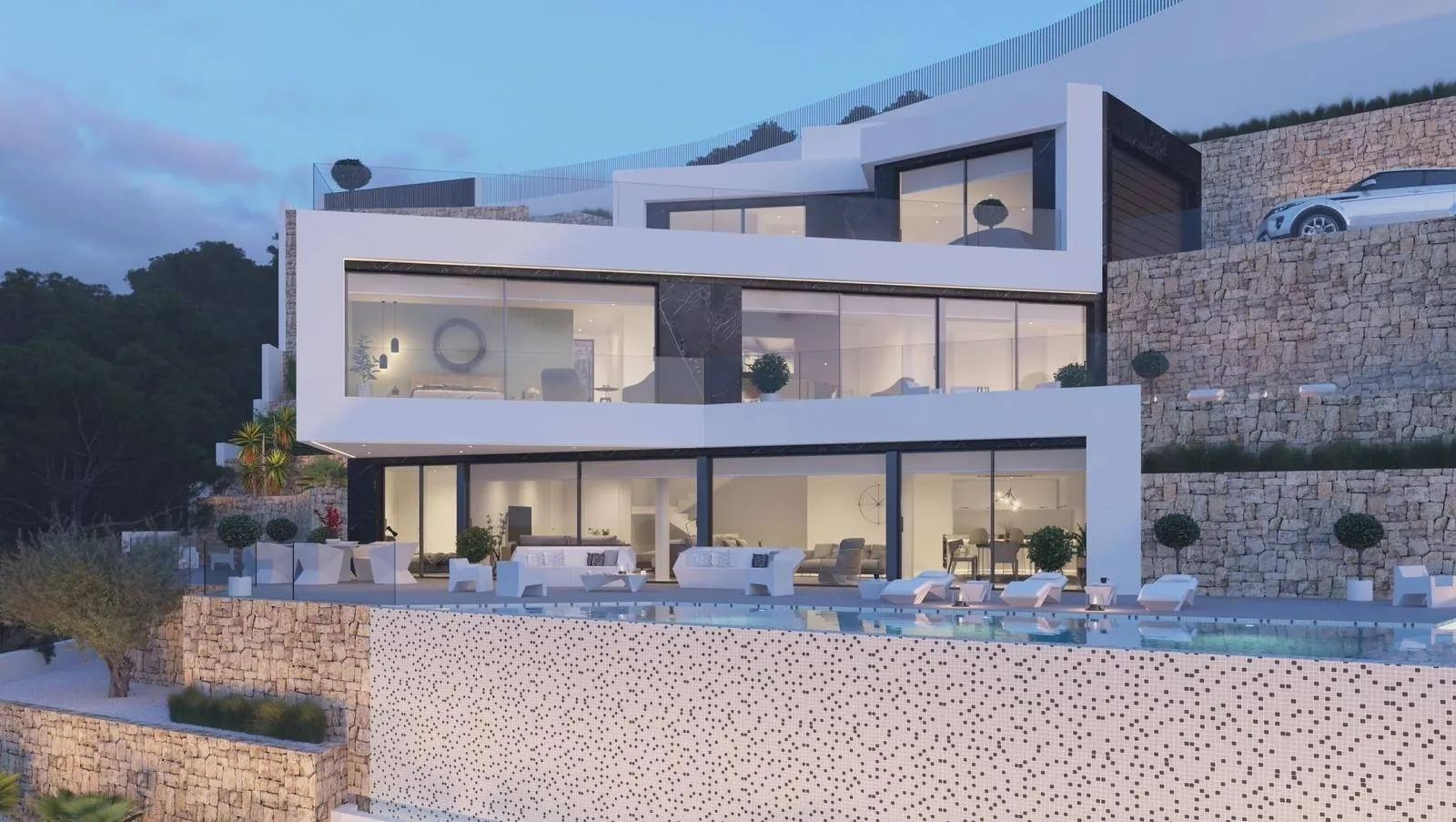
There's a villa currently in development above Benissa, positioned on a south-facing hillside with uninterrupted views across Calpe and out to the open sea. The architecture is precise: floor-to-ceiling glazing, a cantilevered terrace, a palette of poured concrete and aged timber. On paper, it is exactly what a buyer like R.B. is looking for.
The asking price at reservation stage was just over €2.3 million. Construction started six months after he first enquired.
The appeal of buying at this stage is obvious. You're involved. You can, within limits, influence the outcome. Finish choices, tile selections, kitchen specification, bathroom fittings. The home feels authored, not inherited.
But within limits is doing a lot of work in that sentence.
By the time R.B. was in a position to sign, the project had received planning approval with a fixed footprint. The pool couldn't be repositioned. The main terrace orientation, which on the original renders appeared south-west, turned out to face more directly west than he'd assumed. Not a disaster, but not quite what he'd imagined for those early morning hours his wife had in mind. The architect explained, patiently, that the approved plans couldn't be altered at that stage without triggering a full re-submission. Which would mean months of delay. Which would mean missing the window for an early 2027 completion.
He signed anyway. And he's not wrong to have done so. But it's worth being clear-eyed about what design control in a new-build actually means.
At pre-planning or early design stage, a buyer can often shape a project meaningfully. Layout changes, orientation tweaks, spatial decisions. The earlier you're involved, the more genuine the influence. Once plans are approved and groundwork has begun, that window closes. What remains is the interior specification layer: materials, finishes, fittings, landscaping. Meaningful, certainly. But not the same thing as shaping the building.
The better developers operating in the Jávea-to-Moraira corridor understand this and manage it well. They present buyers with clear stage gates: what can be changed before submission, what can't be changed after it, and what remains open throughout the build. A good developer is transparent about this. A less scrupulous one lets you believe you have more control than you do, and that conversation happens after you've transferred your reservation deposit.
Timelines: plan for more than they tell you.
A typical new-build in this segment, from reservation to key handover, is quoted at eighteen to twenty-four months. The reality, based on what we see across active builds in Benissa, Cumbre del Sol, and the hills above Moraira, tends to be more like twenty-two to thirty months. Not always. But often enough to matter.
The reasons are rarely dramatic. Specialist subcontractors working across multiple high-end projects in a region with constrained skilled labour. Material lead times for architectural elements, particularly glazing systems, bespoke joinery, and stone cladding. Occasional municipal delays on intermediate inspections. The aggregation of small slippages that each seem manageable in isolation.
R.B.'s daughter will have finished two years of school by the time the Benissa villa is completed. Which is fine, actually. But it means the family's first proper summer there will be 2028, not 2027. That's a different calculation if you're planning around a specific life stage.
None of this makes new-build the wrong choice. It makes informed expectation the right starting point.
Resale: what you see, largely, is what you get.
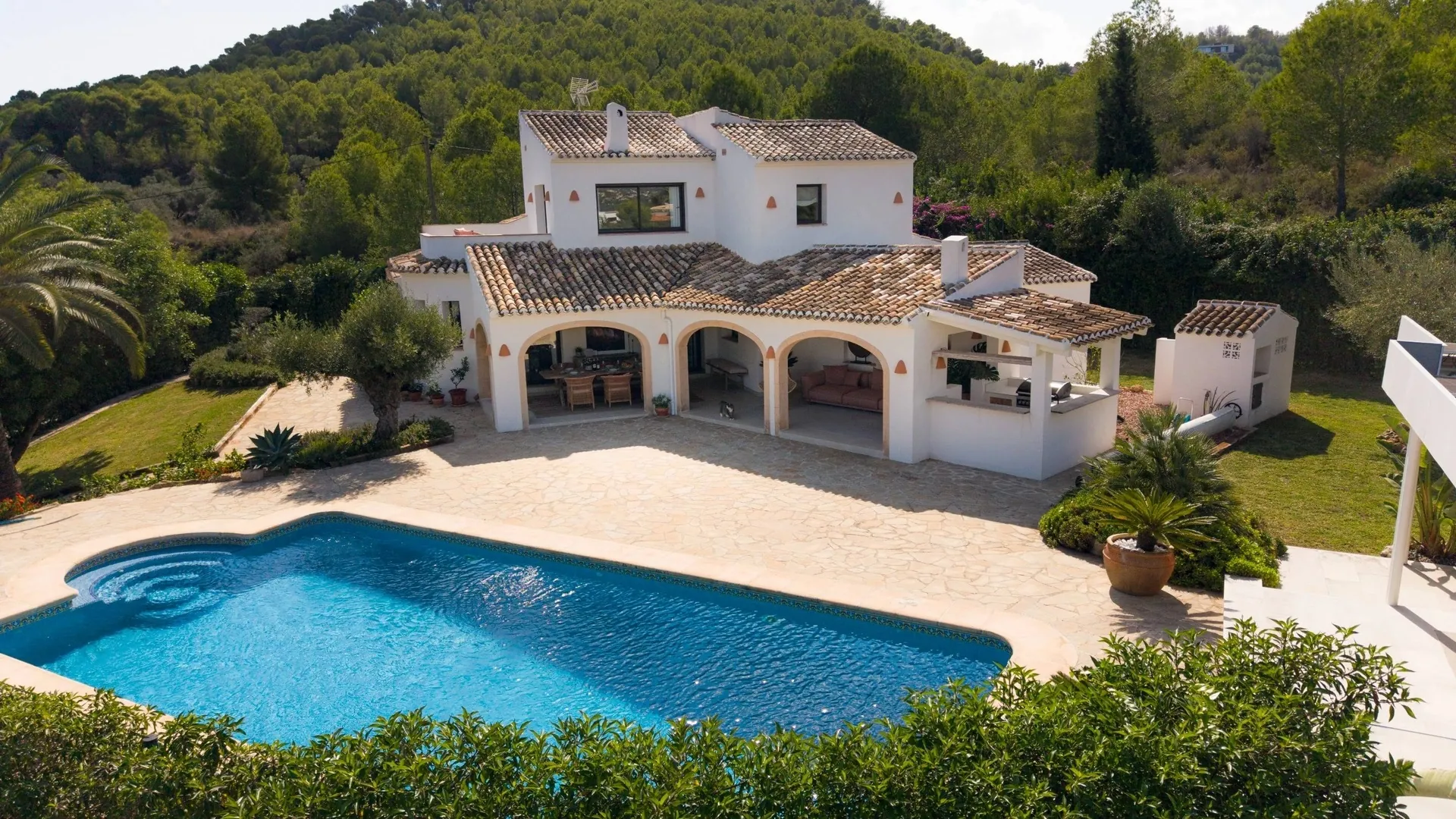
There's a different property R.B. also visited. A completed villa in Jávea’s Adsubia area, renovated in full in 2025, presented in conditions that require nothing. Five bedrooms, a basement with a cinema room and gym, a 14-metre pool aligned to catch the afternoon light. Views across the valley to the coast. The gardens are mature. The bougainvillea has been there long enough to mean something.
The asking price was €2.4 million.
Within twenty minutes he understood the light, the acoustics, the spatial flow, the way the living room connected to the terrace. With the Benissa new-build, he's been extrapolating from renders for eighteen months. With this one, the answer was simply there.
That clarity has real value. So does the absence of a construction risk period, the certainty of the legal position on an existing property with a clear history, and the ability to use it from the moment of completion.
The risks with resale at this level are different but not absent. A full renovation, even a recent one, needs scrutiny. Who did the work? Can the technical certificates be produced? Are the pool, the electrical systems, and the roof under any form of warranty? A competent survey and a careful legal review of the property file are non-negotiable, regardless of how immaculate the presentation appears.
Older properties can also carry planning irregularities, particularly extensions or outbuildings added without formal approval. These are resolvable in many cases, but they need to be identified before purchase, not after.
The other honest observation is this: a high-quality resale at €2.8 million in Jávea or Moraira, in this market, is positioned correctly. These properties have held value well. The renovation cycle in this segment has compressed, with owners investing seriously before sale. What you are often buying is not a compromise, it is a resolved home with accumulated quality that a new-build at the same price point, during and shortly after construction, doesn't yet have.
Quality control: the gap between specification and delivery.
This is where the two options converge on a shared challenge, though in different forms.
In a new-build, the specification agreed at contract stage is the benchmark. If you've chosen a particular stone finish for the kitchen island, a specific brand of aluminium window system, a custom joinery design for the master suite, those choices need to be documented and then inspected at each relevant stage of the build. Verbal agreements with sales teams don't survive personnel changes, subcontractor handoffs, or material substitutions made in the field for reasons of supply or convenience.
A client representative, an independent architect or technical advisor with no financial relationship to the developer, is worth the fee. They attend site at key stages. They photograph. They document deviations. They give the buyer standing in any conversation about remediation.
Without that, what sometimes happens is that the villa delivered at handover is the right size, in the right position, and broadly correct, but the limestone cladding specified is slightly different, the height of the ceiling in the master bedroom was reduced by twelve centimetres during structural coordination, and the kitchen island is a centimetre narrower than drawn because the supplier changed their panel sizing. Each deviation, in isolation, is arguable. Collectively, they represent a finished product that is close to what was agreed, but not precisely it.
For a resale renovation, the equivalent risk is the gap between what appears finished and what has been properly resolved. A beautiful terrazzo floor laid over a substrate that wasn't properly prepared. Underfloor heating that runs from a system sized for a smaller property. These are not hypotheticals. They appear in surveys.
The point isn't that either path is compromised. It's that quality control requires active management, not passive trust.
The case for new-build, made honestly.
At the €2 million-plus level on the Northern Costa Blanca, new-build has genuine structural advantages that are worth stating plainly.
Spanish VAT (IVA) at 10% applies to new residential builds, compared to Transfer Tax (ITP) on resales, which in the Valencian Community currently sits at 10% too. The tax position is therefore comparable, but a new-build typically comes with a 10-year structural guarantee (the Seguro Decenal), builder's liability coverage, and, in most well-run projects, a defects liability period of one to two years post-completion. That post-handover protection matters.
Energy efficiency is another genuine differentiator. A well-built new villa in 2025 and 2026 will carry an A or B energy rating, with properly insulated walls and roofs, high-performance glazing, and solar infrastructure integrated from the start. Retrofitting that quality into an older property is expensive and disruptive. For a family that plans to use the property year-round, eventually, that operational efficiency compounds over time.
And then there is the question of specification purity. Buying at the right stage with the right developer, in a project that is genuinely open to design input before submission, offers something a resale simply cannot: the home is organised around your life, not someone else's. The master suite is positioned where you want it. The guest accommodation is configured for two teenage daughters, with the separation you actually want. The basement is planned for a home office before the structural slab is poured, not carved out afterwards at cost.
Several of the projects currently active in the Moraira and Jávea areas that we work with allow exactly this kind of early-stage collaboration. Villa Celestia above Moraira, for instance, was conceived at a stage where the buyer had meaningful input on the relationship between the living spaces and the view line. That is a different property from one designed speculatively by a developer who then found a buyer.
So which one?
There isn't a universal answer. But there is a useful framework.
If you can absorb a twenty-four to thirty month horizon without it disrupting a specific life plan, and if you find a project at a stage where genuine design collaboration is still possible, new-build in this segment makes a compelling case. The energy credentials, the structural warranties, the absence of embedded renovation history, and the ability to configure the home around your own spatial logic are advantages that compound over ownership.
If you need the property to be usable in the near term, or if you find a resale in the Jávea-Tarraula or Moraira-Benimeit areas that has been resolved to a standard you don't want to second-guess, a well-surveyed resale at this price point is an equally sound decision. The capital preservation record for prime coastal properties in this corridor is consistent. A mature garden, a resolved layout, a known legal position: these are not small things.
What neither path rewards is haste, or incomplete information, or the assumption that the price bracket protects you from the usual risks. It doesn't. It just means the stakes are proportionate.
R.B. ended up signing for the Benissa new-build. He knows the pool can't be moved. He's accepted the timeline. He has an independent technical advisor on retainer for the build phase. And he's made a very clear agreement with the developer, in writing, about the specification commitments that will be honoured at handover.
His wife is already thinking about furniture. His eldest daughter has said she'll come for a week that first summer, before the academic year starts. The younger one wants a ping-pong table on the terrace.
That's what this is really about, in the end. The house is architecture. The decision is life.
If you are considering a property purchase on the Northern Costa Blanca in the €2 million-plus segment, whether new-build or resale, we are happy to talk through the options that are currently available and what each one genuinely involves. We work with a number of properties in private sale, not publicly listed, not widely marketed. If you'd like to talk through what you need, we're easy to reach.
FAQs
How long does a new-build typically take to complete on the Northern Costa Blanca?
Most projects in the €2 million-plus segment quote eighteen to twenty-four months from reservation. In practice, twenty-two to thirty months is more common. Build timelines into your plans accordingly, particularly if you have a specific life event or relocation date in mind.
How much design input can I realistically have on a new-build?
It depends entirely on when you enter the project. Before planning approval is submitted, meaningful changes to layout, orientation, and spatial configuration are usually possible. Once plans are approved and groundwork has started, your influence is largely limited to interior finishes, materials, and landscaping.
Are there properties available that don't appear on public listings?
Yes. A number of properties in this segment are handled privately, without public marketing. These tend to be vendor-led decisions around discretion. Speaking directly with us is the only way to access what is available at any given time.
What are the main risks with a resale property at this price point?
The most common issues are undocumented extensions or outbuildings added without formal approval, and renovation work that looks resolved but hasn't been properly certified. A thorough survey and a careful review of the property's legal file are essential before any purchase commitment.
Is the tax position different for new-build versus resale in Spain?
Both are currently subject to 10% tax in the Valencian Community, IVA on new-builds and ITP on resales. The practical advantage of new-build is the structural guarantee and defects liability coverage that comes with it, which resale properties do not carry unless a recent renovation was formally certified.